Bomb disposal robots already give technicians a way to inspect and handle suspicious objects from a safer distance. The harder question is what happens next: which tasks can autonomous systems perform, and which decisions must stay with a person?
- Remote control will remain central for high-risk work.
- Better sensors matter only when they help a technician make a safer decision.
- Claims about autonomous bomb disposal need dated tests, clear conditions, and named results.
The next step is better remote control
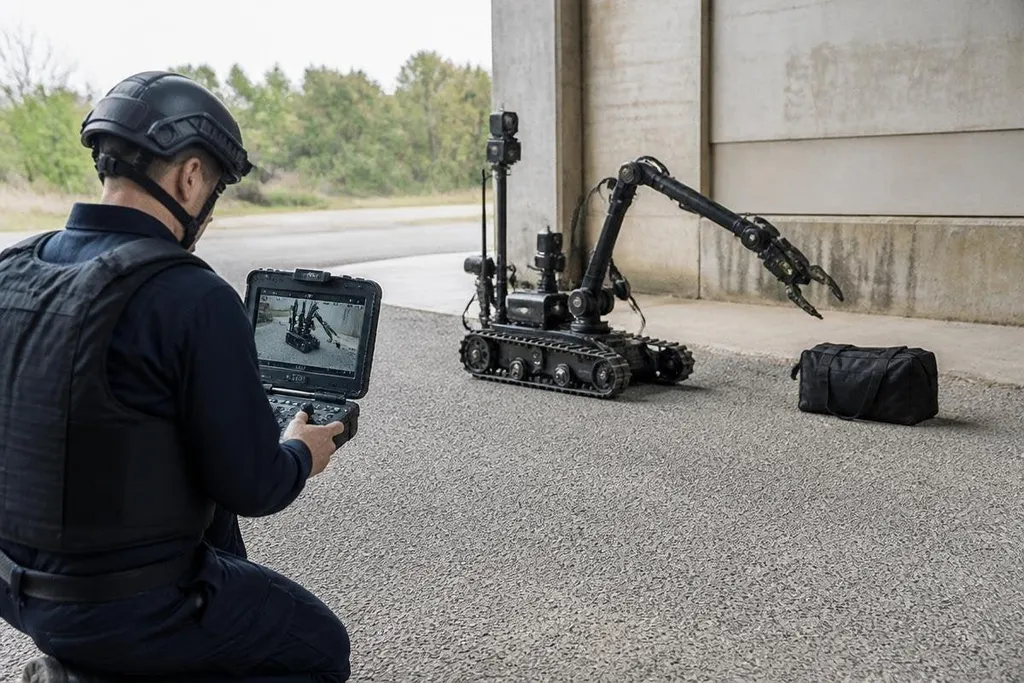
A bomb disposal robot usually combines a mobile base, cameras, an arm, and a tool for handling an object. A technician sends commands from outside the danger area, watches the camera feed, and changes the plan as the scene develops.
That setup leaves little room for a poor control link. Video delay, lost signals, limited camera views, or a gripper that cannot hold an uneven object can stop the task. Future systems will need to show how they behave when a sensor fails or the robot loses contact with its operator.
Teleoperation means controlling a robot from a distance. It will remain useful because suspicious objects rarely appear in the same place, at the same angle, or with the same hazards. A robot can repeat a planned movement, but a person still has to decide whether that movement is safe.
Sensors have to support decisions
More cameras alone won't solve the problem. The useful question is what the robot can measure and how clearly it can show that information to the technician.
A system may need visual images, depth data, and readings from tools placed near an object. Each sensor adds information, but it can also add noise or confusion. The operator needs to know which reading is live, which view is blocked, and what the robot cannot detect.
This is where future product claims need careful testing. A demonstration in a clean training area says little about poor light, tight spaces, damaged surfaces, or objects partly hidden by debris. A serious report should name the test site, the object type, the robot model, and the number of successful and failed attempts.
A report from bomb-disposal robot field tests can place a maker’s claim beside dated trial results and show where the machine still needs an operator. The next step is autonomy for small tasks, with a person ready to take control.
Autonomy will arrive in small tasks
Autonomy does not have to mean that a robot makes every decision. A system might first help with route planning, camera control, object tracking, or a repeatable arm movement while a technician keeps control of the mission.
That path makes sense because each task can be checked on its own. A robot that keeps a camera pointed at a moving object has a smaller job than one that decides how to open a suspicious package. The second task carries a much higher cost when the system gets it wrong.
The open issue is trust. A technician needs to know why the robot chose a route or stopped an arm. A warning without a clear reason can slow the work, while a wrong action can make the scene more dangerous. Any move toward autonomy needs an easy manual stop and a record of what the system sensed and did.
What buyers should ask for
A police unit, military team, or emergency service comparing systems can use this check before accepting a future claim:
- Ask for the test date and site, not a general success claim.
- Check the robot's control range, video delay, battery run time, and recovery process after signal loss.
- Watch an uncut task from approach to tool use and return.
- Confirm which steps remain under technician control.
- Request failure data, service details, spare parts information, and training time.
Those details connect the robot to the work it must perform. They also show where a lower-cost remote system may fit better than a more autonomous one.
The proof that matters next
The next useful milestone is a dated test that compares remote control with limited autonomous functions under the same conditions. Until a maker supplies that record, autonomy claims remain plans rather than results, and bomb disposal teams should buy the system they can supervise clearly today.